Joan Eardley – everywhere!
Not just at the Gallery of Modern Art in Edinburgh and Cyril Gerber Fine Art in Glasgow, but in Berwick-Upon-Tweed too!

Joan Eardley, Summer Sea, Oil on board. (c1960-c1963). Royal Scottish Academy © 2026 Estate of Joan Eardley. All Rights Reserved, DACS.
THINKING OF HEADING for Berwick-upon-Tweed to see "Joan Eardley: The Sea at Catterline" at the Granary Gallery? Be prepared to be drenched, so best to walk in barefoot, or maybe in waders! Eardley's work will not only draw you in, it will leap out and soak you. She liked nothing more than living and painting on the edge, be it the slums of Glasgow, or immersed in the North Sea. As a student she was taught not just to look with her eyes, but to feel with her body.

Market Scene. © Cyril Gerber Fine Art, Glasgow
The Catterline paintings are alive with the power, excitement and danger of a sea that takes no prisoners. When this tiny fishing village saw Joan, driving south from Aberdeen in 1950, it called her home. For her, standing in front of rows of cottages perched on the cliff edge, the big draw was the restless power of the sea at its most awe-inspiring and scary. But oh, so alive, so energetic!
She'd felt vitality in Townhead's slum children, refusing to be suppressed or ignored. Here, in Catterline, she witnessed big seas that could overwhelm and destroy, and Yes! this is where she wanted to be, in the eye of every storm, whip-lashed by wind and icy waves, returning again and again to the same spot, month after month, always more to discover and feel.
She wasn't the first artist who divided their time between city and sea, balancing the supposedly civilised and the wild. Turner was famously strapped to a ship's mast in stormy seas, a latter-day Odysseus, defying the Sirens' efforts to lure him into the next world. Like him Eardley was mesmerised. Wave, after wave, after wave… .

The Plough. © Cyril Gerber Fine Art, Glasgow
Three qualities define her work: Humanity, Vitality, Engagement. Her life was framed by the fall-out from land-grabs, industrialisation, and two world wars; all legacies of human greed and lust for power.
The Highland Clearances saw many summarily evicted from crofts to make way for profitable sheep. Some had little choice but to join fishing communities. Others found new lives in factories and shipyards on Clydeside. Others emigrated to far-flung corners of Empire.
For those in power and authority then, as now, humanity was a resource, exploited to win wars and generate profit, never mind the cost to people or planet. And so, in 1929, aged eight, Joan lost her father, a victim of shell-shock, shattering his dreams of farming in Sussex. 1940 found her living with her mother's family in Bearsden, East Dunbartonshire, a year into another war.
She enrolled at Glasgow School of Art, receiving her diploma in 1943, recognised as having exceptional talent. 1949 saw her in Italy on a Carnegie scholarship awarded by the Royal Scottish Academy.

Reclining Nude. © Cyril Gerber Fine Art, Glasgow

Reclining Nude. © Cyril Gerber Fine Art, Glasgow

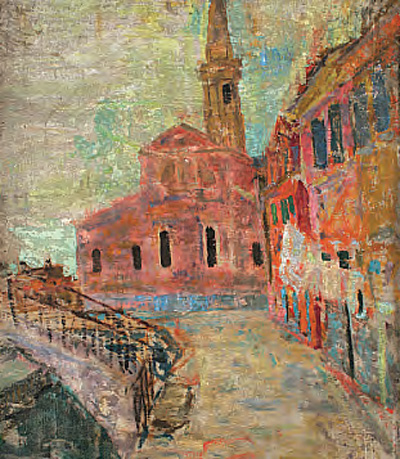
Beggars in Venice '48/49. © Cyril Gerber Fine Art, Glasgow
girlwribbon
This Italian trip opened her eyes not just to great painters of the early Renaissance like Giotto, Masaccio, and Piero della Francesca, but also to the suffering, poverty and degradation that war had left in its wake (so poignantly seen in Fellini's classic film La Strada). Her love of the sea, and of fishing villages took her to Tuscany's Versilia Coast. Visiting Venice, her subject was not canals and palazzos, but beggars. Given her humanity and compassion for her fellow human beings, it's not surprising that, returning to Glasgow, she chose to live and work in an inner city slum: Townhead.
For her, work meant engagement, immersion in the life of her subject, slum children. To express suffering, or poverty, or hardship? No! To "let out their life, energy, colour, richness, a living thing...as long as Glasgow has this I'll always want to paint". Her words. Her special talent?
The ability to express that primeval energy, that compression of time and space, and drag it onto canvas and inside a frame, along with actual bits of cityscape, landscape, or seascape, all keen to join the party; old sweet wrappers, grass, sand and grit.
The result? Her subjects come alive, be it children, fields of corn, wind... or waves. Turn away, and see something different when you look back, for there's too much to take in in one look. They draw you in again, and again. Be careful though, mind that wave!
The exhibition includes work by artists of Eardley's creative community including Lil Neilson and Margot Sandeman.
Curated in partnership with The Fleming Collection and part of RSA200: Celebrating Together. Granary Gallery, Berwick. June 6 – October 11, 2026. Wednesday – Sunday. 11am-4pm £ 7.50.
www.maltingsberwick.co.uk/whats-on/joan-eardley-the-sea-at-catterline-exhibition-entry-day-ticket/